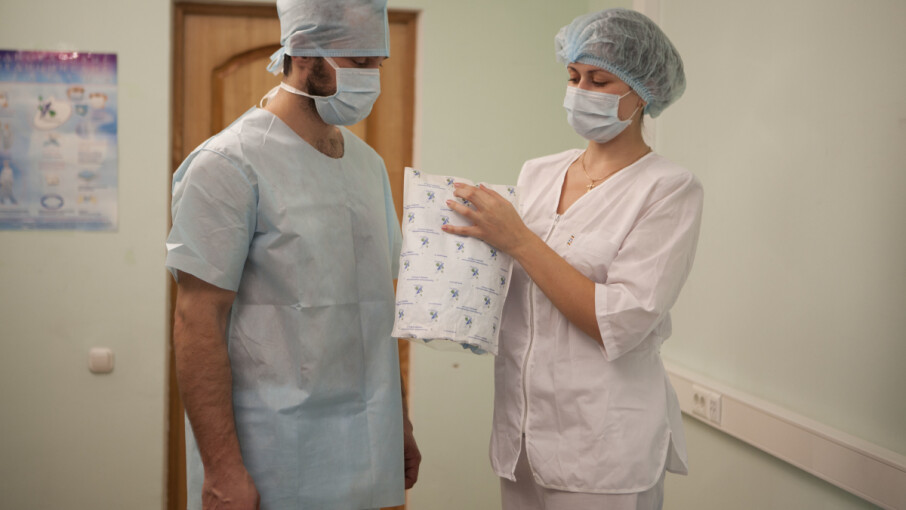
Gexa’s manufacturing facility in Dubna may be called the huge company’s cradle. This is where the first Gexa nonwoven materialss were made in 1988. Originally, they included simple gowns and even headrest covers for aeroplane chairs. These days, this is the leader of complex medical items production.
Dubna contains the business ‘brains”, i.e. the R&D shop yielding new models and retrofits. Ludmila Litke, CEO of the Dubna facility, describes this in detail below.
The Dubna production cycle starts with acceptance of the materials supplied by our branch in Toropets. The supplies vary from straight materials, i.e. spunbond, spunlace, SMS, etc., to semi-finished or finished products that need to be completed by us as medical sets. Then the supplies are moved to the shops, e.g. the cutting site or a packing unit. The most interesting part of our Dubna branch is the complex products sections. That’s where sophistifated surgical items, such as sheets for angiography and thoracic surgery and underwear for trauma and orthopedic surgery, are produced and folded in a special way. One can say that Dubna is one of the few places in Russia where such products are manufactured.
The facility puts out over 1,000 models of sophisticated products!
This helped Gexa – Nonwoven Materials OOO become the market leader in the field. Ludmila Mikhailovna points out: ‘While in the past our hospitals favoured the imports, nowadays they are considering our products. They make comparisons, and, as it turns out, the domestic items are not inferior at all. Therefore the demand is growing.’
Every production stage is exposed to continuous control to meet the requirements for the medical products. What is more, the checking is done not only by the quality control experts, but also by the operators themselves – in the process of cutting, weelding and packing. At any moment, once a defect is found, the whole batch is rejected to avoid any penetration of inferior goods into the market.
The company performs extra testing of its products for sterility. Sterilisation is done by a third party, which issues quality certificates for each batch. Yet, the Dubna branch goes for the secondary testing of sterile products by another third party. Ludmila Mikhailovna sums up: ‘This is not mandatory and not required by either the Russian GOST or ISO, but we have decided for ourselves that we want to do it to be absolutely sure of the quality of the products our factory supplies to the market. So we are not afraid about the patients, for we know that our products are sterile and there can’t be any trouble.’
Все товары предоставлены в нашем каталоге, а также на маркетплейсах